 A procurement manager once emailed me a purchase order for 40,000 medical protective coveralls. The technical description read: “non-woven, waterproof, white.” That was it. Four words standing between a hospital’s nursing staff and whatever walks into the triage room on a bad Tuesday. He wasn’t being careless. He simply didn’t know which questions to ask, and nobody on the supplier side had volunteered the answers.
So let’s fix that.
THE WORD “PROTECTIVE” MEANS ALMOST NOTHING ON ITS OWN
Search any B2B marketplace and you’ll find thousands of listings using the same vocabulary: protective, disposable, medical-grade, anti-virus, waterproof. None of those words are regulated. A coverall that keeps dust off a painter’s shirt and a coverall that holds up against pressurized liquid chemical jets can both be marketed as “protective.” The only thing that separates them is a certification number printed on the label and a test report nobody asked for.
That’s where standards come in. They’re not bureaucracy. They’re the difference between a garment that has been mechanically challenged by a lab and a garment that has been described nicely by a copywriter.
THE EN 14126 SUFFIX IS THE PART MOST BUYERS MISS
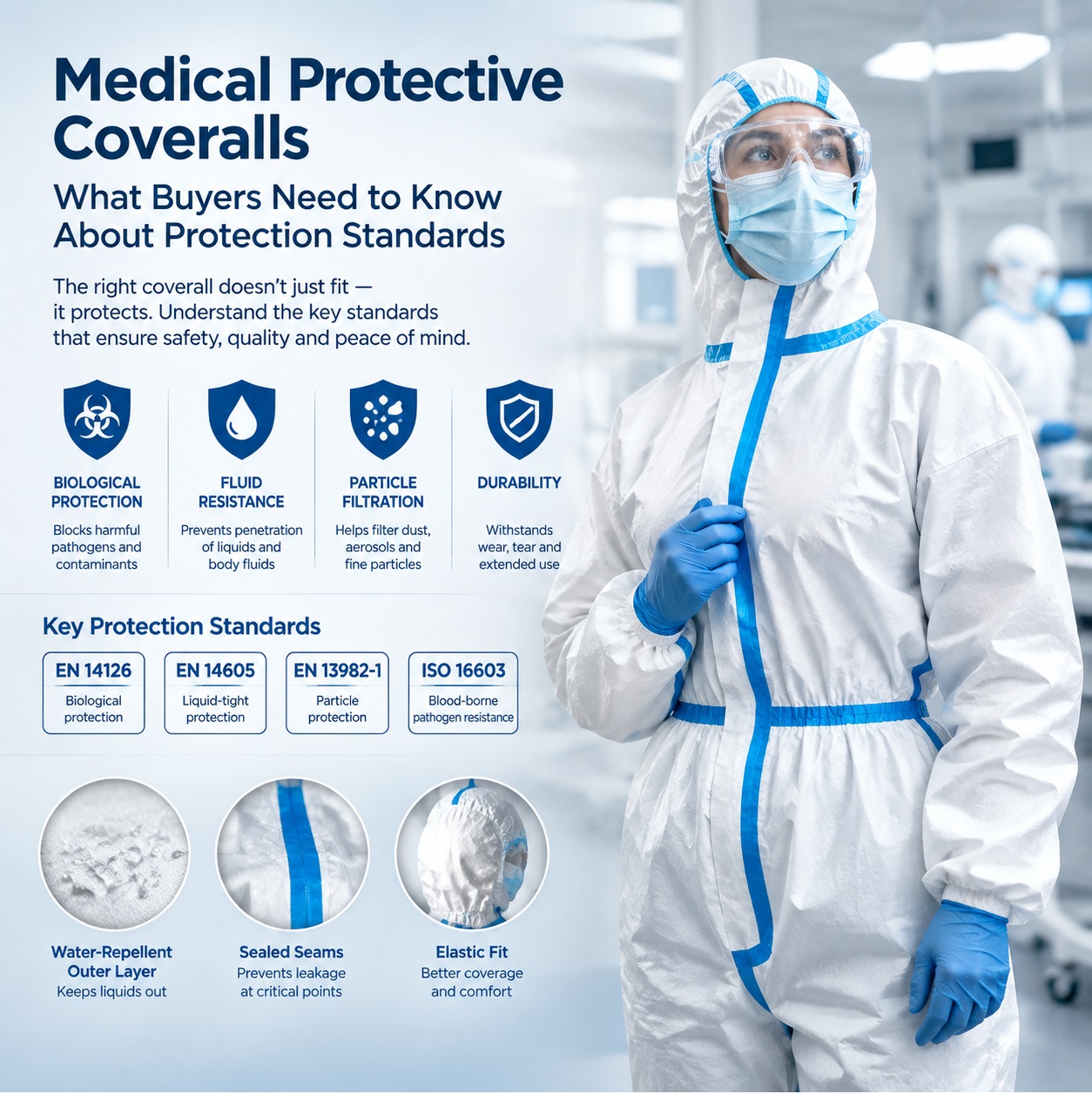
If you’re sourcing for healthcare, infection control, or any environment where blood, body fluids, or aerosolized pathogens are in play, the standard you want on the certificate is EN 14126. It’s the European standard for clothing protecting against infective agents, and it’s the closest thing the industry has to a meaningful benchmark for medical coveralls.
But here’s the trap. EN 14126 is not a standalone type classification. It’s a suffix that gets attached to a base type. A coverall certified to Type 6 with infective agent protection reads as “Type 6-B.” A Type 3 version reads as “Type 3-B.” That letter matters enormously.
The base types break down roughly like this:
Type 1 and Type 2 are gas-tight and non-gas-tight suits for chemical emergencies. You will almost never buy these for clinical use.
Type 3 is liquid-tight, tested against a directed jet of liquid. Type 4 is spray-tight. These are the heavyweights, and they’re what you want for high-volume fluid exposure or decontamination work.
Type 5 covers airborne solid particulates. Type 6 covers limited liquid splashes and light aerosol. Type 6 is the workhorse of most medical procurement, and it’s also the most frequently overstated.
Now the -B suffix. To earn it, the fabric and seams have to pass four separate test methods: resistance to penetration by synthetic blood under pressure (ISO 16603), resistance to bacteriophage penetration (ISO 16604), wet bacterial penetration under mechanical contact (ISO 22610), and dry microbial particulate resistance (ISO 22612). A coverall can pass the base type test with flying colors and still fail every one of those. Two different products. Same glossy brochure.
SEAMS FAIL BEFORE FABRIC DOES
Ask any lab technician which part of a coverall gives out first and you’ll get the same answer. It’s never the fabric. It’s the seam.
Untaped stitched seams are essentially perforated lines running down the arms, legs, and torso. Under any meaningful fluid pressure, they leak. Taped seams — heat-sealed over the stitch line — are what close that gap, and they’re the single most common cost-cutting target when a supplier is shaving pennies off a quote.
There are four seam constructions you’ll encounter: simple stitched, overlocked, bound, and taped. Only taped seams belong on a garment making Type 3, Type 4, or Type 6-B claims. If the spec sheet doesn’t state the seam construction, assume the cheapest one and price accordingly.
CERTIFICATES ARE NOT ALL THE SAME DOCUMENT
This is the part where experienced buyers get burned.
A test report is a lab’s raw data on a sample of fabric. It tells you the material performed a certain way on a certain date. It does not certify the finished garment, it does not cover the manufacturing process, and it expires in relevance the moment the fabric or factory changes.
An EU type-examination certificate is a different animal. It’s issued by a notified body, it names the specific product model, and it references the exact standards the garment meets. Under EU Regulation 2016/425, coveralls protecting against infective agents are Category III PPE, which means the manufacturer must hold both a type-examination certificate and either a production quality assurance system or ongoing product surveillance.
Verify the certificate. Every notified body has a four-digit identification number, and those numbers are searchable in the European Commission’s NANDO database. If the number doesn’t resolve, or the certificate’s product description doesn’t match what’s on the box, walk away. Counterfeit and recycled certificates are common enough that verification should be a routine step, not an act of suspicion.
For US buyers, the landscape splits. Coveralls marketed for medical use with claims about bloodborne pathogen protection may fall under FDA device regulation, while worker protection obligations run through OSHA and reference standards like NFPA 1999 for emergency medical operations. ASTM F1670 and F1671 govern material resistance to synthetic blood and bacteriophage respectively — the same science as the ISO methods, different paperwork.
THE SPEC SHEET QUESTIONS THAT SEPARATE SUPPLIERS
When you’re evaluating quotes, these five questions will tell you more than any product photo:
What is the certified type, and what is the EN 14126 suffix if applicable?
What seam construction is used, and is it taped?
Can you send the full test report, not a summary page?
Which notified body issued the type-examination certificate, and what is its number?
What is the fabric weight in grams per square meter, and does it change between sizes?
That last one matters more than people expect. Some suppliers thin the material on larger sizes to keep costs flat. A size XXXL coverall made from lighter fabric is not the same product as the size M you tested.
SIZING AND DONNING ARE PART OF THE PROTECTION SYSTEM
A perfectly certified coverall worn two sizes too small will tear at the shoulder when the wearer lifts a patient. One worn too large will bunch and snag on equipment. The hood gapes, the ankles ride up, the zipper flap folds the wrong way. Certification assumes the garment is worn as intended, and “as intended” includes fit.
Buyers should demand a size chart with body measurements, not just S through XXL letters. If the supplier can’t tell you the chest and inseam dimensions for each size, they haven’t thought hard about how the garment performs in motion.
WHAT YOU’RE ACTUALLY PAYING FOR
The price gap between a certified Type 6-B coverall with taped seams and a generic non-woven alternative is real, and it’s usually between 30 and 70 percent. That number looks like a lot on a spreadsheet. It looks considerably smaller next to a single infection incident, a regulatory finding, or a staff member who spent three weeks wondering whether they were exposed.
The honest position is this: not every task needs Type 4. Overbuying protection wastes money and creates heat stress that leads to doffing errors. But the decision should be made deliberately, based on the exposure risk, the standard, and the documentation — not on whichever listing had the nicest stock photo.
Ask for the certificate. Check the number. Look at the seams. It takes ten extra minutes, and it’s the cheapest insurance in the entire procurement process.